16+ Years of Experience in Airports & Aviation Sector
Master Degree in Airport and Aeronautical Safety Management -ITAérea Aeronautical Business School , SPAIN

The International Civil Aviation Organization (ICAO) -The ICAO Framework
"Understanding the ICAO Framework: Safeguarding Global Aviation Standards"
Aviolead
1/28/20262 min read
Foundation for Global Aviation
• Established in 1944 for aviation oversight
• A specialized agency of the United Nations
Standards and Practices
• Sets crucial safety, security, and efficiency standards
Member States Collaboration
• Facilitates cooperation among 193 countries
Aviation Development
• Aids in economic growth and cultural exchange globally
Route Expansion
• Fosters planning and development of international air transport
Economic and Cultural Integration
• Enhances global trade and tourism
Adaptive Strategies
• Evolves with technology and geopolitical shifts
Sustainability and Safety
• Advocates for eco-friendly and secure aviation practices
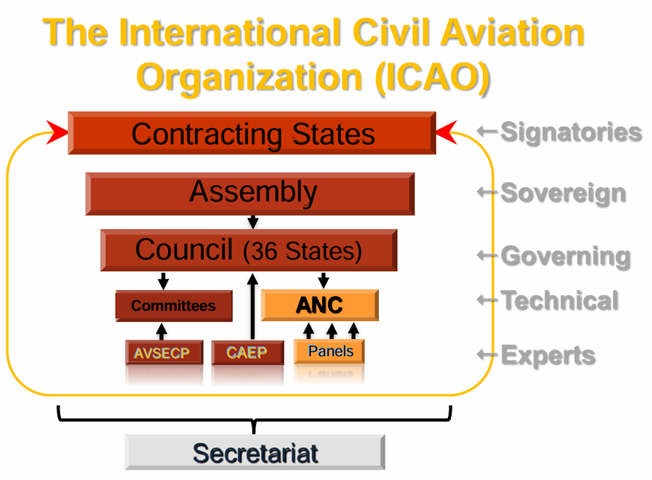
1. Contracting States
These are the 193 member states that have ratified the Chicago Convention (1944), which established ICAO.
They are the sovereign signatories to the convention and hold ultimate authority over ICAO’s policies and direction.
In the diagram, they are shown at the top as the highest authority — they elect the Council, approve budgets, and adopt amendments to ICAO Annexes (standards and recommended practices).
2. Assembly
The supreme governing body of ICAO.
Composed of representatives from all Contracting States.
Meets every three years to set general policy, approve the budget, and elect members of the Council.
It functions as the “parliament” of ICAO.
3. Council
· A governing body elected by the Assembly for a 3-year term.
· Consists of 36 member states chosen based on their importance in air transport (traffic volume, geographic representation, etc.).
· Acts as the executive board between Assembly sessions.
Responsible for:
1. Adopting international standards (Annexes to the Chicago Convention)
2. Monitoring compliance
3. Coordinating technical assistance
Reporting to the Assembly
4. Committees
· Technical bodies that support the Council in specific areas such as:
o Air Navigation Commission (ANC)
o Air Transport Committee
o Legal Committee
o Finance Committee
· They provide expert advice and draft recommendations or standards for the Council’s approval.
5. Air Navigation Commission (ANC)
· A key technical body composed of 19 aviation experts appointed by the Council.
Responsible for:
· Developing and amending Annexes to the Chicago Convention (e.g., Annex 6 on Aircraft Operations, Annex 13 on Accident Investigation)
· Ensuring technical consistency and global harmonization of aviation standards
· Works closely with Panels (see below) and reports to the Council.
6. Panels
· Smaller, specialized working groups under the ANC.
· Composed of technical experts from member states and industry.
· Focus on specific technical issues (e.g., flight data recorder standards, runway safety, airspace design).
· Develop detailed proposals and draft text for new or revised standards, which are then reviewed by the ANC and approved by the Council.
7. Secretariat
· The permanent administrative body of ICAO.
· Headquartered in Montreal, Canada.
· Led by the Secretary General, who is appointed by the Council.
Responsible for:
· Day-to-day operations
· Implementing decisions of the Assembly and Council
· Providing technical assistance and training to member states
· Publishing documents, managing meetings, and coordinating global aviation programs
8. Supporting Bodies Mentioned:
· AVSECP (Air Navigation Services and Infrastructure Committee)
· Focuses on air traffic services, infrastructure, and operational procedures.
· CAEP (Committee on Aviation Environmental Protection)
· Addresses environmental issues like aircraft noise, emissions, and climate impact.
Summary in One Sentence:
ICAO’s structure ensures that sovereign states govern through the Assembly and Council, while technical experts (through ANC and Panels) develop global standards, all supported by a permanent Secretariat that implements and coordinates international aviation policy.
Phone: +966 55 469 0122
Address: Riyadh, Saudi Arabia